Category: Blogging

A Day with Camphor

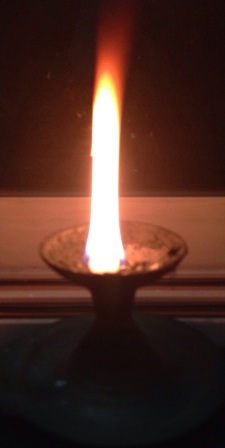
burning camphor

Standing before the deities placed in the temple of our home, we begin our day offering prayers for our well being. The usual ritual includes lighting the lamp, incense stick, and burning the camphor. Incidentally camphor has taken a centre stage in my life, though my reverence began with it as a symbol of religion.

In fact, every temple in India makes use of camphor for arati (offering camphor lamp). Nevertheless, the cumulative effect of the camphor and the ringing bells turns therapeutic. It stirs various emotions and the mind goes into abeyance.

When I burn camphor and watch its progress, it reminds me of a stage by stage ‘purification of soul’; metaphorically speaking. Watching the ‘white, volatile, crystalline substance’ disappear, little by little, has often made me aware of the reality; and its perfume a reminder of cleansing.

Apparently, some of the practitioners of alternative and complementary treatment methods (e.g. Healing, Reiki) recommend the use of camphor. Probably, for those who deal with the ways of the subconscious and the spiritual, camphor becomes synonymous with well-being. Of course, religion and spirituality has had a deep-rooted relation.

Indeed, the medicinal property of camphor is world renowned, especially in home remedies. Be it an insect bite or cough, a pure camphor is crushed, mixed along with the relevant natural products and served as a cure. Interestingly, it has found its way into kitchen as a flavouring agent.   However, we have to make sure it is not the “easily available” synthetic camphor.

As the day comes to an end, following the ritual of lighting the lamp in the evening, I reach out the lit matchstick to the camphor. In an instance the fire catches, sways and takes the melting camphor along. It burns till the last flicker, leaving no past to worry about. My mind starts reeling.
Street Shopping, A Bargainer’s Delight!

A friend, who had come down to Mumbai on a short visit from the United States, was very keen on shopping. She had a day in hand. Her idea of owning ‘a party-wear salwaar kameez( Indian dress), fancy bangles, and mouth watering chaats (Indian snacks) ’, made me select a mall in the vicinity that had all ‘possible brands, cleanliness, and cool environment to beat the heat’.

Surprisingly, she made a humble request to go “street shopping” instead. Wow! Now, for someone who likes to wander, wonder and wriggle through the crowd of fellow wanderers by the roadside, the experience at street markets like Linking Road (Bandra West) and Fashion Street (South Mumbai, near Churchgate) is joie de vivre. Clothes, bags, accessories, sandals, including the latest fashion trends – you just have to name it.

What is even more enticing is the price quoted for the products. In ordinary words, the look-alike of any branded clothes come at half its price. “So cheap, you see!” She was overjoyed. Within minutes she was busy scouting for her goods. And with every shop she stopped by, she was gaining confidence in bargaining. At a point she mentioned “how much she enjoyed persuading and convincing.” It was a surprise indeed.

Of course, bargaining is a skill that comes with practice. In fact, I see it as a tool of communication. Here, the seller and the buyer both are aware of the rules of bargaining. Each has adorned their persuading and influencing skills to the finest. However, some of the buyers are so convincing with their reasoning that, the stall owner gives up ultimately.

Apparently, some of these stalls have a regular customer relationship. Yet, the shoppers/customers bargain and the shopkeeper/seller hands over the goods, saying “sirf aap ke liye” (only for you). But those shops/stalls that don’t encourage bargaining make their position clear with a ‘Fixed Rate’ board.

Well, there are interesting tips on bargaining pointed out by many like-minded bargainers on the World Wide Web. However, not many of us are good at bargaining. When it comes to the “real” thing, we oblige the sellers blindly. As for my friend, her happy hours in Mumbai were a dream come true, and with the “savings” she bought food and shared it with an elderly destitute.

Cornering Corn

We ambled along the shore enjoying the music that played from an unknown corner, on a Sunday evening. People had thronged from near and far. The food stalls, ice-cream carts, fancy balloons and colourful toys were welcoming the strangers enthusiastically. Not to forget the nariyal paani (coconut water) and the bhutta (roasted corn).

A typical scene. Beaches around Mumbai have a familiar pattern. Interestingly, the beaches in India  seem to be picking up similar patterns. Yet, bhutta-wallahs (roasted corn vendors) in Mumbai have an exceptional flavour, probably it is their unique selling point.

They roast the corn on smouldering coal. Once the kernels change colour to a deeper shade with scatters of burnt black here and there, the bhutta-wallah removes it from the coal.  With a wedge of lemon, s/he smears the masalas, chili powder and salt to taste, as per our requirement.

A bite into the roasted corn stirs the palate with an array of flavours, and surprisingly the kernels are fresh and juicy. It is a wonder that, in spite of going through a process of fire and burns, the corn oozes the freshness as if it were untouched!

We continued our walk along the beach relaxing to the Nature’s treat and savouring the delicious corn. Somewhere, deep down, my heart was thanking the unknown person who had stumbled upon the recipe of a perfect bhutta.

Magic of Cubes, A Puzzle!

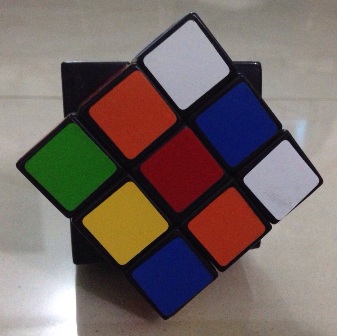
Rubik's Cube

Age has never dampened the spirit of heart while playing games. Instead the child in us awakens to competitive spirit and winning. As I am writing this blog, I can see my husband thinking and working his hands on the Rubik’s cube. I should say, like the many others around the world, we have succumbed to the magic of cubes; and often find ourselves drawing patterns to solve the puzzle!

Indeed, it appears to be a simple colourful cube with coloured stickers of red, blue, yellow, green, orange and white that waits to be twisted, turned and configured into same-colour combination on each side.

The moment we lay our hands on it, our minds surrender to its puzzling mishmash. When least expecting, we are rewarded with the perfect cubic arrangement too. However, we have still not managed to find “how we got it correct”.

The story of Rubik’s cube began with Erno Rubik’s 1974 invention of “a working model to help explain three-dimensional geometry.” A work of art, the mobile sculpture was thought of as a symbol of ‘stark contrasts of human conditions such as simplicity, complexity, stability and dynamism’.

Eventually, this professor of architecture in Budapest (Hungary) managed to solve the Cube for himself in well over a month’s time. Amazingly, these magic cubes have become one of the world’s best selling toys.

Solving puzzles are the most addictive games and mental exercises that have remained stable in our life. From playing scrabble to chess, bubble-shooter to bridge games, there is an assortment of mind games. Little wonder then, to find a Rubik’s cube making its way not only to a child’s toy collection but also to the office recreation.