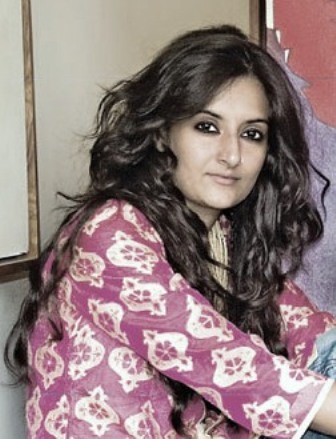
Artist Payal Khandwala has a nice way of expressing her subjects with lines. By Deeya Nayar-Nambiar
“Lines are perhaps the most integral component of form and structure. It is this framework with which the artist visualises a drawing, sculpture or painting. In their purest form, lines come together to plot a narrative; in a non-figurative work they form the building blocks for the subsequent abstraction,” explains Payal Khandwala, a contemporary artist who has carved a niche for herself with her drawings and oil on canvas.
Payal moves her hands with ease whether it is a sketch or a painting and the lines and hues in her work make you think and decode the hidden symbolism. Payal does create an abstract visual language. In fact she constructs a physical reality for a unique intangible moment that is open to interpretation. According to her, “The mark an artist chooses to make ultimately set him apart from another; it is with this vocabulary that he will create a vision that is unique.”
Payal emphasises that when she is painting she tries to distance herself from symbolism altogether, but she does not try to make them narratives. Most of her work is abstract and she makes use of elements like colour, texture, organisation, and sometimes order and geometry.
When she works with the human figure, she tries to keep it uncomplicated. “If it is the face that inspires me, then that is all I include. I don’t like to put in a social, political or gender context into my work,” she explains. But what inspires Payal as an artist? Very thoughtfully she puts it to “many things” – urban landscape, cities like Mumbai and New York where she spent her formative years, textiles, old peeling walls, colours, textures, human forms that surround us.
But Payal is a loyalist when it comes to her colours. She says her palette is an integral part of her painting vocabulary and the slight shift of colours – glazing and making it vibrate to create a visual sensation – is central to her work. In fact she feels that controlling colours allows each painting to have its own mood.
Payal is an art and textile designer from SNDT in Mumbai and holds an honours degree in fine arts and illustration from Parsons School of Design in New York. She also got a diploma from Metafora, an international workshop for contemporary art in Barcelona. To some extent a background in textile design continues to influence Payal’s work. “I’m very receptive to vegetable dyes and Indian textiles that have such a rich and varied history. I tend to retain what inspires me and it forms part of my visual memory bank,” she says.
Payal also likes to experiment in order to break from the monotony of grayscale with dash of colour here and there in figures, adding elements of fun and humour to them. This gives a relief to her work as she tries to develop themes she is not comfortable with. This is evident from the way she has interpreted the Kamasutra in a playful sort of way, keeping the scale of the drawings small true to the miniatures but flooding it with colour.
Talking about her drawings she says, “The subject often determines this choice of line. Gestures, contours, movement have the power to change lines. The medium and scale allow spontaneity and chance and gives the map texture and weight.”
Similarly, her oil on canvas is intrinsic to cultural influences. “Without adhering to the strict formalism of tradition, the work strives to explore a new vocabulary to communicate the emotion behind an experience and to replace what recognisable symbols ordinarily represent.”
Of course, drawing and painting needs both patience and perseverance since no idea can be captured in a day’s time. And beyond that? “I’m just happy to continue doing what I’m…I try not to make many plans. This way I don’t have to break them,” she signs off.
Published in btw, Chitralekha Group


 Variety is the Spice of Life