Author: Deeya Nambiar

I believe in taking every day as a learning phase, and exploring my writing skills. I have enjoyed the challenges as a journalist, content writer and college lecturer, and at the moment am living life analysing the extraordinary in the ordinary!

Wasting Time A Creative Gain?

wasting time one

Idling away time with a pen/pencil and paper often brings the creative side in us. A few strokes, dots, and circles are the first work of art. If the paper has some printed date column or a picture,  over-writing on them with scatter of flowers soon follows. Still not convinced, practice signatures, writing name over and over. Wonder, how many wavering thoughts pass by.

Ultimately, the shapes move on from circles, triangles and squares to drawing disfigured people. With it feathers creative thinking and the lines become bolder in creating a desired look. Amazing it is, to observe the passing thoughts settling for stability.

When amongst friends, we share a joke about the drawing: compare them to each other, put words into them and make them a representation of us. At times the imagination is far better than the reality that we are faced with. And we simply love it.

However, the practice, not very much appreciated, is glared at as “wasting time”. When questioned, our answer remains, “I had nothing better to do.” Interestingly, it is one of those “wasted moments” that reward a flight of imagination. It causes unrestrained wandering and willing submission of our mind.

Yeah! We keep knocking at the door of creativity.

No doubt, The Department of English at the University of Pennsylvania has given a serious thought before formulating the course titled ‘Wasting time on the Internet’ (Spring, 2015). Indeed, wasting time is not creating, but a serendipitous moment of creative flicker.

Dearly Beloved Diary

diary old

I’ve lost some friends

I truly cherished,

For whom I’m greatly sorrowed

These friends aren’t humans who have perished.

They’re books that humans borrowed.

This little poetry, I could not recollect the name of the poet, was published in Reader’s Digest years ago. I had written it down from my habit of collecting quotes and poetry. With time, my habits changed and the sources of happiness were many in the offing. And the collection of quoted wisdom was lost in the familiar surroundings of my home.

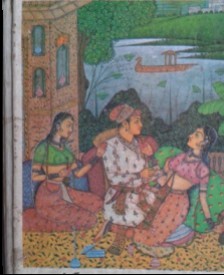
Abandoned to the point of being burnt, recently, the oldest of the diaries was recovered from the amassed fortune of old and out-of-print publications. It has a cover print of Mughal miniature painting, the precise reason for making it a precious book.

The years rolled backwards. I glanced through the pages of quotes/poems. From Bhagavad Gita to Sri Ramakrishna Paramahamsa’s words and H.W. Longfellow to W.B Yeats, there were many known, anonymous and translations.

Some philosophical and some practicality, yet they all spoke the same language – Language of Life. I felt, as if, I was having a secret communication: the words that weaved a way of life to humble living and deep thinking. The book appeared to be life personified.

Old and yellowing pages, delicate to touch, made it difficult for me to leaf through the pages. My emotions reined my thoughts. Ironically, the page that turned without much fuss was to the poem “Dearly Beloved”.

The diary was my dearly beloved possession long time ago, not “borrowed” or shared. Yet, I lost her in transition for reasons I cannot recollect. However, the fading handwritten words promised a reunion, and held a lifetime teaching… (A Malayalam translation quoted on the facing page of “Dearly Beloved”)

“As the sand drifts away below our feet when we stand on the seashore, the days roll on, never to come back.”

A Day with Camphor

burning camphor

Standing before the deities placed in the temple of our home, we begin our day offering prayers for our well being. The usual ritual includes lighting the lamp, incense stick, and burning the camphor. Incidentally camphor has taken a centre stage in my life, though my reverence began with it as a symbol of religion.

In fact, every temple in India makes use of camphor for arati (offering camphor lamp). Nevertheless, the cumulative effect of the camphor and the ringing bells turns therapeutic. It stirs various emotions and the mind goes into abeyance.

When I burn camphor and watch its progress, it reminds me of a stage by stage ‘purification of soul’; metaphorically speaking. Watching the ‘white, volatile, crystalline substance’ disappear, little by little, has often made me aware of the reality; and its perfume a reminder of cleansing.

Apparently, some of the practitioners of alternative and complementary treatment methods (e.g. Healing, Reiki) recommend the use of camphor. Probably, for those who deal with the ways of the subconscious and the spiritual, camphor becomes synonymous with well-being. Of course, religion and spirituality has had a deep-rooted relation.

Indeed, the medicinal property of camphor is world renowned, especially in home remedies. Be it an insect bite or cough, a pure camphor is crushed, mixed along with the relevant natural products and served as a cure. Interestingly, it has found its way into kitchen as a flavouring agent.   However, we have to make sure it is not the “easily available” synthetic camphor.

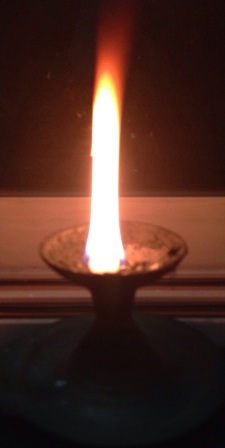
As the day comes to an end, following the ritual of lighting the lamp in the evening, I reach out the lit matchstick to the camphor. In an instance the fire catches, sways and takes the melting camphor along. It burns till the last flicker, leaving no past to worry about. My mind starts reeling.

Street Shopping, A Bargainer’s Delight!

A friend, who had come down to Mumbai on a short visit from the United States, was very keen on shopping. She had a day in hand. Her idea of owning ‘a party-wear salwaar kameez( Indian dress), fancy bangles, and mouth watering chaats (Indian snacks) ’, made me select a mall in the vicinity that had all ‘possible brands, cleanliness, and cool environment to beat the heat’.

Surprisingly, she made a humble request to go “street shopping” instead. Wow! Now, for someone who likes to wander, wonder and wriggle through the crowd of fellow wanderers by the roadside, the experience at street markets like Linking Road (Bandra West) and Fashion Street (South Mumbai, near Churchgate) is joie de vivre. Clothes, bags, accessories, sandals, including the latest fashion trends – you just have to name it.

What is even more enticing is the price quoted for the products. In ordinary words, the look-alike of any branded clothes come at half its price. “So cheap, you see!” She was overjoyed. Within minutes she was busy scouting for her goods. And with every shop she stopped by, she was gaining confidence in bargaining. At a point she mentioned “how much she enjoyed persuading and convincing.” It was a surprise indeed.

Of course, bargaining is a skill that comes with practice. In fact, I see it as a tool of communication. Here, the seller and the buyer both are aware of the rules of bargaining. Each has adorned their persuading and influencing skills to the finest. However, some of the buyers are so convincing with their reasoning that, the stall owner gives up ultimately.

Apparently, some of these stalls have a regular customer relationship. Yet, the shoppers/customers bargain and the shopkeeper/seller hands over the goods, saying “sirf aap ke liye” (only for you). But those shops/stalls that don’t encourage bargaining make their position clear with a ‘Fixed Rate’ board.

Well, there are interesting tips on bargaining pointed out by many like-minded bargainers on the World Wide Web. However, not many of us are good at bargaining. When it comes to the “real” thing, we oblige the sellers blindly. As for my friend, her happy hours in Mumbai were a dream come true, and with the “savings” she bought food and shared it with an elderly destitute.